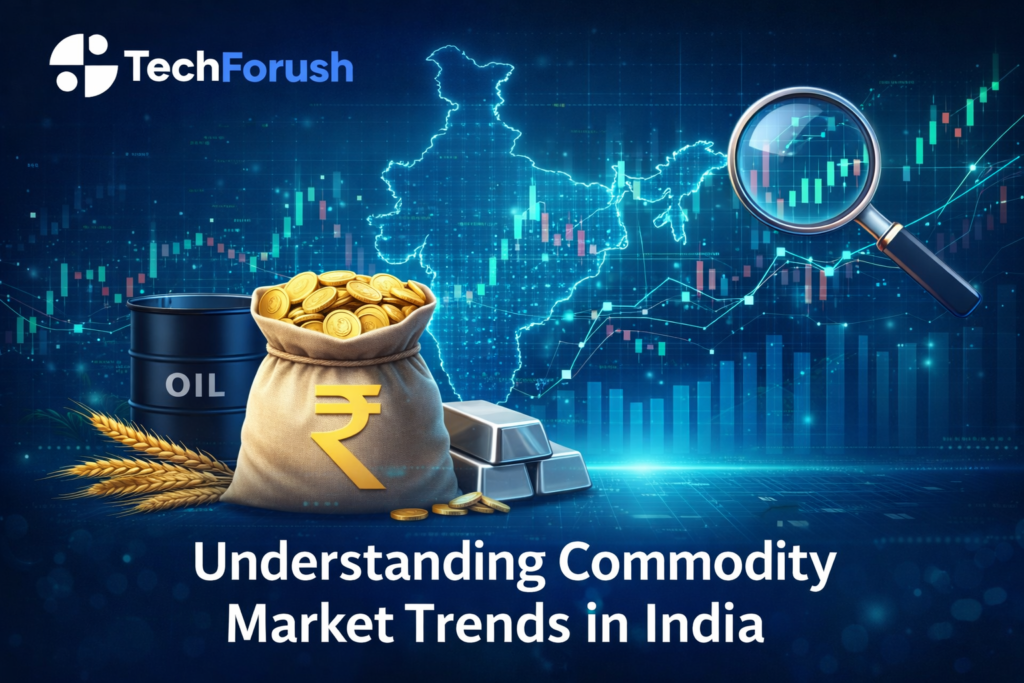
Visual representation of commodity market trends in India, highlighting gold, oil, agriculture, and financial analytics.
Silver Is Not What Most People Think It Is
Most people would think of jewellery when you question them about silver. Some cash in a drawer, a set of earrings, or a necklace. That image is not wrong — but it is embarrassingly incomplete. Silver is one of the most industrially active metals on the planet right now, and its role in shaping commodity market trends in India is far larger than most retail investors give it credit for.
It has been mined for over 5,000 years. The earliest records go back to Anatolia — what we now call Turkey. Since then, the world has found increasingly sophisticated uses for it, from currency to cutlery to, more recently, solar panels and 5G infrastructure. Mexico, Peru, China, and Australia together supply more than half of global silver output. A good chunk of the rest comes as a by-product of mining other metals entirely — gold, copper, zinc, lead. That dependency on other mining operations makes silver supply genuinely unpredictable at times, which is part of what keeps traders alert.
Why the Price Never Sits Still for Long
Silver has a reputation for volatility, and it earns that reputation regularly. On any given week, prices can shift in response to US Federal Reserve commentary, a geopolitical flare-up in a major producing region, or simply a change in industrial demand forecasts. When interest rates drop, silver becomes more attractive because the cost of holding a non-yielding asset falls. When global uncertainty rises, investors treat it almost like a second gold — a safe-haven play that carries additional upside tied to industrial demand.
That combination of investment appeal and industrial relevance is what makes following NCDEX silver contracts genuinely interesting. Unlike purely speculative assets, silver’s price has real-world anchors — solar panel manufacturers need it, electronics producers cannot easily replace it, and medical equipment relies on its antimicrobial properties. When industrial demand picks up faster than supply can respond, prices move — and they move quickly.
What Makes the Silver Rate in Mumbai Particularly Interesting
The silver rate in Mumbai does not simply mirror international spot prices. It never has. Local factors layer on top of global movements in ways that matter enormously for anyone buying or selling physical silver in the city. Import duties shift the cost base. A 3% GST applies at the point of purchase. The rupee’s movement against the dollar changes what international prices actually mean in Indian terms. And then there is Mumbai’s own rhythm — festival seasons, wedding months, and the sheer volume of industrial buyers operating out of the city — all of which influence local demand in ways no international benchmark fully captures.
Zaveri Bazaar remains the beating heart of Mumbai’s physical silver trade, and the prices quoted there on any morning carry a story behind them that goes well beyond what a simple chart shows. Tracking the silver rate in Mumbai through reliable, live platforms before making any purchase or trade is not optional — it is the bare minimum of informed decision-making.
Before You Trade or Buy, Know What You Are Getting Into
If you are trading NCDEX silver, understand that contracts are denominated in 30 kg units, and the costs involved — brokerage, storage, transaction charges — eat into returns more than many first-time commodity traders expect. Regulatory compliance is non-negotiable, and the market can move against you sharply on macro news days.
For physical buyers, purity is everything. 99.9% of investment-grade silver is very fine. Sterling silver, which is often used in ornaments, makes up 92.5% of the metal. All silver goods sold in India must have BIS hallmarking from 2021, and the 2025 revision to the hallmarking rules makes it simpler than ever to confirm what you are actually purchasing. Ask for a statement all the time. Always check the hallmark. And if you are planning to hold silver beyond three years, be aware that profits are treated as long-term capital gains and taxed at 20%.