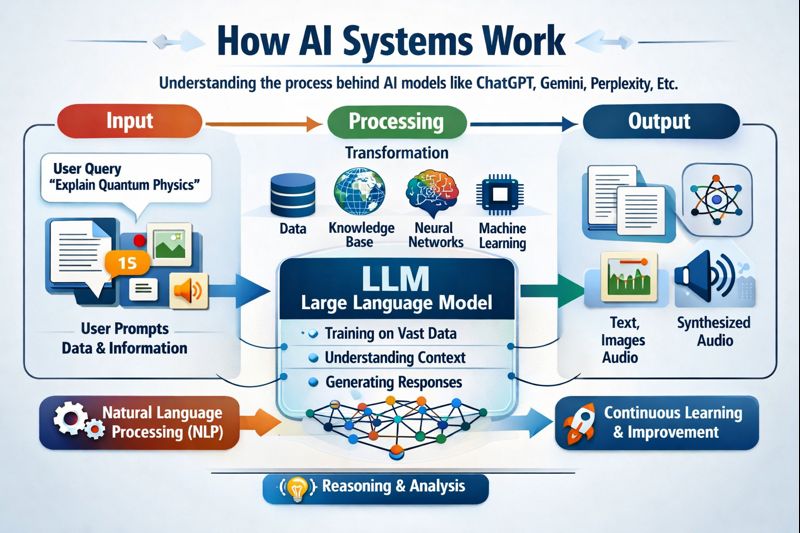
Artificial Intelligence (AI) has become an essential part of our digital lives. From chat assistants and search engines to recommendation systems and automation tools, AI is working silently in the background. But many people still ask one fundamental question: How do AI systems actually work?
This guide explains how AI systems work step by step, focusing on modern AI tools such as conversational AI, generative AI, and Large Language Models (LLMs). The explanation is simple, informative, and technically accurate—perfect for beginners as well as professionals.
What Is an AI System?
An AI system is a combination of data, algorithms, computing power, and models designed to mimic human intelligence. Instead of thinking like humans, AI systems identify patterns, predict outcomes, and generate responses based on mathematical probability.
Modern AI does not “think” or “understand” like humans. It works by transforming input data into output results using trained models.
The Core Working Flow of AI Systems
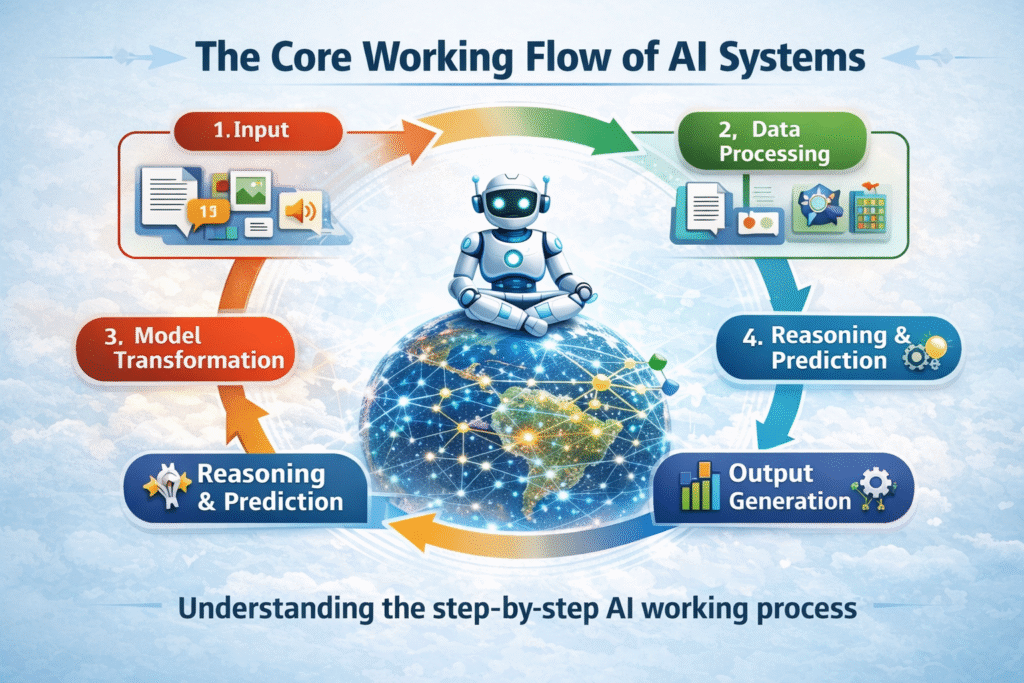
Almost every AI system follows the same fundamental process:
- Input
- Data Processing
- Model Transformation
- Reasoning & Prediction
- Output Generation
- Learning & Improvement
1. Input: How AI Receives Information
The first step in how AI systems work is input collection. Input can be provided in many forms, such as:
- Text (questions, commands, documents)
- Voice (speech, audio commands)
- Images (photos, scans, videos)
- Structured data (tables, numbers, logs)
For example, when a user types a question into an AI chat tool, that text becomes the raw input.
Before AI can use this input, it must be converted into a format machines understand. This leads to preprocessing.
2. Data Preprocessing and Tokenization
AI systems cannot directly understand human language. They first convert input into tokens.
What Are Tokens?
Tokens are smaller units of text such as:
- Words
- Parts of words
- Characters
For example:
“How AI systems work”
becomes tokens like:
how | ai | system | work
This process is part of Natural Language Processing (NLP), which enables machines to analyze language structure, grammar, and meaning.
Preprocessing also includes:
- Removing noise
- Standardizing text
- Encoding information numerically
3. Transformation Using AI Models
This is the core stage where modern AI systems operate.
Most advanced AI tools today are based on Transformer architecture, which allows models to understand context and relationships between words.
Why Transformation Matters
Transformation means:
- Converting input tokens into mathematical vectors
- Comparing them with learned patterns
- Understanding context instead of isolated words
This is why AI can differentiate between:
- “Apple the company”
- “Apple the fruit”
The system uses attention mechanisms to focus on relevant words and ignore unnecessary ones
4. Large Language Models (LLMs) at Work
Large Language Models are trained on massive amounts of data, including:
- Books
- Articles
- Websites
- Code
- Conversational text
When generating an answer, the AI:
- Predicts the most likely next word
- Builds sentences step by step
- Ensures logical flow using context windows
5. Reasoning and Context Understanding
Modern AI systems use context awareness to maintain conversation flow.
Key capabilities include:
- Understanding intent
- Remembering recent context
- Identifying relationships between concepts
- Applying logical constraints
For example, if a user asks follow-up questions, AI connects them with previous inputs to maintain continuity.
This stage is often called reasoning, though it is computational rather than human reasoning.
6. Output Generation
Once processing and prediction are complete, the AI generates output in the required format, such as:
- Text responses
- Images
- Audio
- Code
- Data summaries
The output is optimized for:
- Relevance
- Clarity
- Natural language flow
Importantly, AI does not copy answers from the internet. It generates new content based on learned patterns
7. Learning and Model Improvement
AI systems improve through training and fine-tuning, not real-time learning from individual users.
There are three main learning methods:
1. Supervised Learning
AI learns from labeled data (questions + correct answers).
2. Unsupervised Learning
AI identifies patterns without predefined labels.
3. Reinforcement Learning
AI improves through feedback, rewards, and penalties.
Modern AI systems also undergo:
- Safety tuning
- Bias reduction
- Accuracy improvements
- Performance optimization
How AI Differs From Human Intelligence
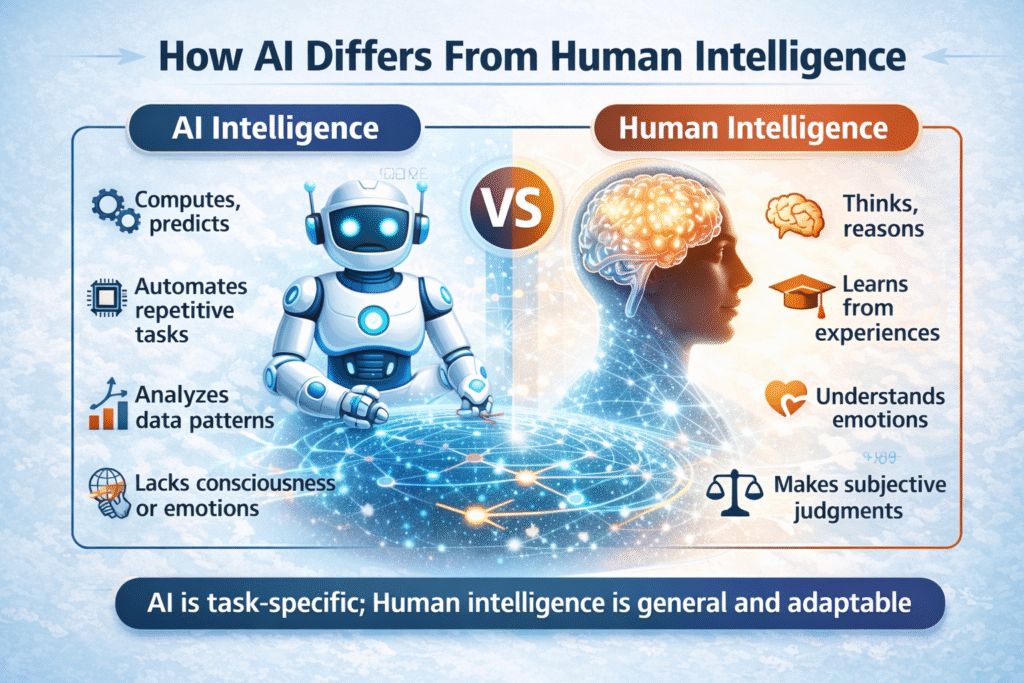
Understanding how AI systems work also means understanding their limitations.
AI can:
- Process massive data fast
- Detect hidden patterns
- Automate repetitive tasks
AI cannot:
- Feel emotions
- Have consciousness
- Possess personal experiences
- Make moral judgments independently
AI intelligence is narrow and task-specific, not general human intelligence.
Real-World Applications of AI Systems
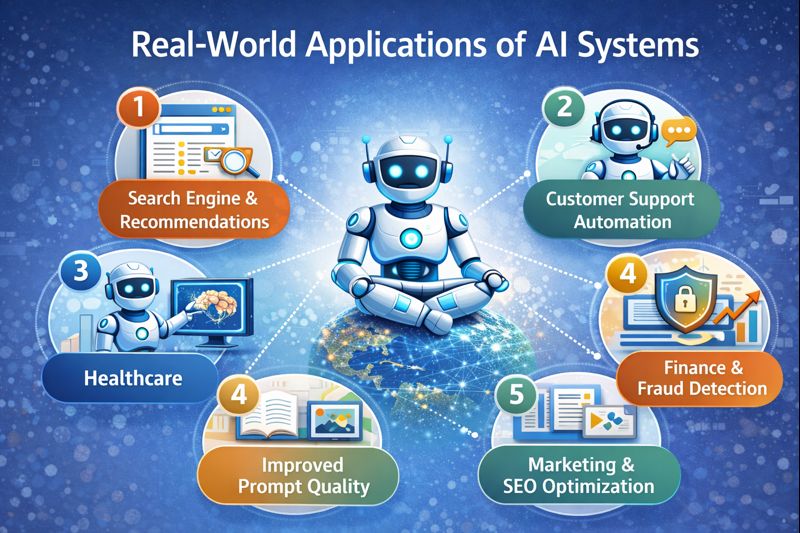
AI systems are widely used across industries:
- Search engines and recommendation systems
- Customer support automation
- Healthcare diagnostics
- Finance and fraud detection
- Content generation and analysis
- Marketing and SEO optimization
Their effectiveness depends on data quality, model design, and ethical implementation.
Why Understanding How AI Systems Work Matters
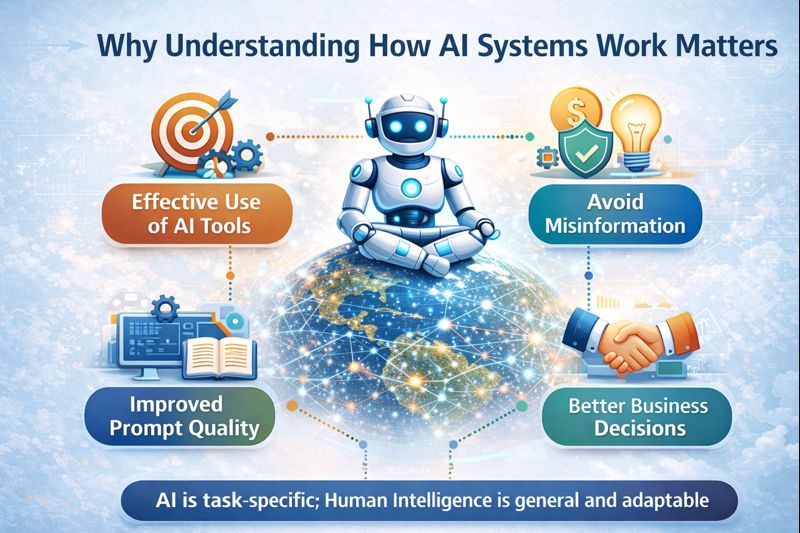
Knowing how AI works helps users:
- Use AI tools more effectively
- Avoid misinformation
- Improve prompt quality
- Make better business decisions
- Build trust in AI systems
Conclusion
They work by transforming human input into mathematical representations, processing them through advanced models like transformers, predicting outputs using probability, and generating meaningful responses—all without consciousness or intent.
AI is not magic. It is mathematics, data, and engineering combined intelligently.
As AI continues to evolve, understanding its working process will become an essential digital skill for individuals and organizations alike.
Frequently Asked Questions – (FAQs)
1. How do AI systems work globally across different platforms?
AI systems work using the same core principles worldwide—input processing, data transformation, and model-based prediction. Regardless of platform or country, AI models analyze data patterns using algorithms and trained datasets to generate accurate outputs.
2. Are AI systems language-independent?
AI systems are language-agnostic at the core but trained separately for multiple languages. Advanced AI models support multilingual processing through Natural Language Processing (NLP), allowing them to understand and generate content in many global languages.
3. What technologies power modern AI systems?
Modern AI systems are powered by machine learning, deep learning, transformer models, neural networks, and large-scale data processing. These technologies enable AI to understand context, perform reasoning, and generate human-like responses.
4. Is AI data usage the same across countries?
AI systems follow global standards but comply with regional regulations such as GDPR (Europe), CCPA (USA), and other local data protection laws. Responsible AI systems are designed to ensure data privacy, security, and ethical usage worldwide.
5. Why is understanding how AI systems work important for global businesses?
Understanding AI systems helps global businesses improve automation, customer experience, decision-making, and scalability. It also ensures better adoption of AI tools while maintaining compliance with international standards and user expectations.